
June 2025 Market Update
Members of the Federal Reserve are sending mixed signals regarding the possibility of an interest rate cut in July.
The Fed’s Federal Open Market Committee (FOMC) has left the target range for the Federal Funds Rate unchanged at 4.25 to 4.5 percent since December. Following its June 18 meeting, the committee noted that, “recent indicators suggest that economic activity has continued to expand at a solid pace. The unemployment rate remains low, and labor market conditions remain solid. Inflation remains somewhat elevated.” All signs that an interest rate cut is not likely anytime soon.
Following that meeting, though, two members of the FOMC indicated that they plan to back a rate reduction at the panel’s July 29-30 meeting.
“If you’re starting to worry about the downside risk [to the] labor market, move now, don’t wait,” Federal Reserve Governor Christopher Waller said. “Why do we want to wait until we actually see a crash before we start cutting rates? So I’m all in favor of saying maybe we should start thinking about cutting the policy rate at the next meeting, because we don’t want to wait till the job market tanks before we start cutting the policy rate.”
Three days later, Federal Reserve Governor Michelle Bowman expressed a similar sentiment, though with some hedging, stating at a conference in Prague, “Should inflation pressures remain contained, I would support lowering the policy rate as soon as our next meeting in order to bring it closer to its neutral setting and to sustain a healthy labor market.”
The FOMC has 12 members, including Chair Jerome Powell, who was noncommittal about the timing of monetary policy in his June 24 testimony before Congress.
“I would say this: If it turns out that inflation pressures do remain contained, then we will get to a place where we cut rates sooner rather than later,” Powell told members of the House Financial Services Committee. “But I wouldn’t want to point to a particular meeting, I don’t think we need to be in any rush because the economy is still strong. The labor market is strong.”
Several members of the committee have expressed concern that the Trump administration’s tariffs could drive up inflation, with Powell noting, “We do expect tariff inflation to show up more, but I want to be honest, we really don’t know how much of that is going to be passed through to consumers.” If inflation rises, then an interest rate reduction would become much less likely, as the Fed would focus more on restraining price increases than stimulating the economy.
President Trump, however, has remained insistent that the central bank should do more about the latter, calling Powell a “very dumb, hardheaded person” in a June 24 social media post for his reluctance to cut rates.
“We will be paying for his incompetence for many years to come,” Trump wrote.
The Fed’s preferred measure of inflation, the Personal Consumption Expenditures (PCE) Price Index from the Bureau of Economic Analysis, showed year-over-year price increases of 2.1 percent in April, down from 2.3 percent in March. The Federal Reserve’s target inflation rate is 2 percent.
“If there wasn’t a trade war going on, we all might have been impressed by the resumption of inflation progress and the return of headline inflation to target,” an analyst at CIBC Capital Markets wrote, according to MarketWatch. “Today’s [PCE] data and the unpredictability of trade policy in Washington will reinforce the Fed’s desire to wait things out.”
Continued growth in the labor market could help to enable a patient approach. The economy exceeded expectations in May by adding 139,000 jobs, as the unemployment rate stayed at 4.2 percent.
“We’re seeing a softening in the labor market,” an EY economist told Yahoo Finance. “That’s undeniable. But it’s not a retrenchment in the labor market. And that’s what was feared.”
Consumers appear uncertain about the economic outlook, as The Conference Board’s Consumer Confidence Index dipped 5.5 percent from May to June.
“Consumers were more pessimistic about business conditions and job availability over the next six months, and optimism about future income prospects eroded slightly,” the board’s senior economist, global indicators, said, adding, “Tariffs remained on top of consumers’ minds and were frequently associated with concerns about their negative impacts on the economy and prices. Inflation and high prices were another important concern cited by consumers in June.”
The University of Michigan’s Index of Consumer Sentiment, though, rose in June for the first time this year, increasing nearly 16 percent from May.
“Consumers appear to have settled somewhat from the shock of the extremely high tariffs announced in April and the policy volatility seen in the weeks that followed,” the university’s Surveys of Consumers director said. “However, consumers still perceive wide-ranging downside risks to the economy. Their views of business conditions, personal finances, buying conditions for big ticket items, labor markets, and stock markets all remain well below six months ago in December 2024. Despite this month’s notable improvement, consumers remain guarded and concerned about the trajectory of the economy.”
Confidence remains middling in the manufacturing sector, with the Institute for Supply Management’s Purchasing Managers Index slipping in May to its lowest point since November and, for the third straight month, sitting below the level delineating expansion and contraction in the sector.
“Contraction in most of the indexes that measure demand and output have slowed, while inputs have started to weaken,” the chair of the institute’s Manufacturing Business Survey Committee said.
“The relatively subdued sales are largely due to persistently high mortgage rates,” the association’s chief economist said. “Lower interest rates will attract more buyers and sellers to the housing market.”
The National Association of Home Builders/Wells Fargo Housing Market Index in June slipped 5 percent from May, and the association reported that its “survey also revealed that 37% of builders reported cutting prices in June, the highest percentage since NAHB began tracking this figure on a monthly basis in 2022.”
The Dow Jones Industrial Average closed at 42,206.82 on June 20, down 1.4 percent since Trump became president, while the S&P 500 Index ended the day at 5,967.84, up 1.5 percent in the previous five months.
The dollar, as of June 20, was trading at 0.87 euros, 0.75 pounds, 145.92 yen and 7.18 yuan.
June 2025 Steel Shorts
Trump Doubles Steel, Aluminum Tariffs to 50%
President Trump on June 3 issued a proclamation doubling the tariffs on steel and aluminum imports to 50 percent.
The action was taken, according to the proclamation, because the metals “are being imported into the United States in such quantities and under such circumstances as to threaten to impair the national security of the United States.”
“In my judgment, the increased tariffs will more effectively counter foreign countries that continue to offload low-priced, excess steel and aluminum in the United States market and thereby undercut the competitiveness of the United States steel and aluminum industries,” Trump stated in the proclamation. “Although the previously imposed steel and aluminum tariffs have helped provide critical price support in the United States market, they have not yet enabled these industries to develop and maintain the rates of capacity production utilization that are necessary for the industries’ sustained health and for projected national defense needs.”
Canada, the largest foreign supplier of steel and aluminum to the United States, indicated that it might soon retaliate with increased tariffs of its own, depending on the progress of negotiations that are expected to be completed in July.
“Canada will adjust its existing counter-tariffs on U.S. steel and aluminum products on July 21 to levels consistent with progress made in the broader trading agreement with the United States,” Canadian Prime Minister Mark Carney said.
Mexico, another major metals supplier to the United States, is negotiating to replace the tariffs with a quota system, according to Bloomberg.
The tariff increase became effective on June 4.
Nippon Buys U.S. Steel for $14.1 Billion
Nippon Steel has completed its $14.1 billion purchase of U.S. Steel.
The proposed sale was rejected on national security grounds by the Biden administration in January, and President Trump had expressed opposition to it before being elected. Trump softened his position in recent months, though, first suggesting that Japan-based Nippon could hold a minority investment in the iconic American company, then backing the deal once it was revised to give the federal government a “golden share.” This gives Trump – by name – significant influence over major company decisions, as well as the ability to appoint a member to the Board of Directors.
“They kept asking me over and over, and I kept rejecting it, no way, no way, no way,” Trump said. “The deal got better and better and better for the workers. I’m going to be watching over it. It’s going to be great.”
After Trump leaves office, control of the golden share will be held by the Treasury Department and the Commerce Department.
U.S. Steel reportedly will retain its name and branding.
German Official Seeks Steel Summit After Abandonment of Green Project
Germany’s vice chancellor and finance minister is calling for a steel summit after plans for a green steel project in the country fell through.
ArcelorMittal, the world’s second-largest steel producer, was to receive 1.3 billion euros in subsidies to make two German steel plants carbon-neutral. Even with the government assistance, though, the company said that energy costs were too high for the project to be feasible.
Vice Chancellor Lars Klingbeil, a Social Democrat, responded to the news by calling for a meeting that would bring together various stakeholders in the steel sector, according to Clean Energy Wire.
“I have approached the economy minister with a request to bring all the players to the table,” Klingbeil said, adding, “We want Germany to have a strong industry. This includes ‘green steel’ for future viability.”
Nucor Experiences Hack, Data Breach
Nucor, America’s largest steel producer, reported to the Securities and Exchange Commission (SEC) that data was stolen during a breach of its IT systems.
As a result of the “cybersecurity incident,” Nucor reported in its June 20 8-K filing to the SEC that, “in an abundance of caution, the Company temporarily and proactively halted certain production operations at various locations.”
“The Company’s investigation revealed that a threat actor illegally accessed the Company’s information technology systems,” Nucor stated. “The cybersecurity incident resulted in a temporary limitation of access to portions of the Company’s information technology applications supporting some aspects of the Company’s operations at some of the Company’s facilities. … The Company’s investigation also determined that the threat actor exfiltrated limited data from the Company’s information technology systems.”
Nucor noted that, “the affected production operations, and access to necessary affected information technology applications, have been restored, and the Company believes that the threat actor no longer has access to the Company’s information technology systems.”
The person or entity responsible for the incident has not been identified.
CUSTOMS CORNER
Section 232 Duties on Base Metals – Current and Future
Currently (June 2025) there are duties imposed under a Section 232 finding on steel and aluminum products and derivatives of those metals. There are also current investigations under Section 232 of copper (HTS Chapter 74) and derivatives, and processed critical minerals and derivatives (excluding the steel and aluminum products covered by the existing Section 232 finding.) Critical minerals include all base metals covered by HTS Chapters 75 and 78- 81, as well as minerals and other materials in other Chapters. While these investigations remain ongoing, once reports and recommendations are issued by the Commerce Department, Section 232 duties and/or other trade restrictions could be imposed on any or all of these additional products.
Steel and Aluminum
President Trump in his first term initiated a Section 232 investigation on steel and aluminum. Following the Commerce Department report, he imposed duties of 25% on specified steel products and 10% on specified aluminum products, including a small number of so-called “derivative” products. Mr. Trump created a program for exclusions, on request by importers, for products not readily available from U. S. producers, and (eventually) exempted products from Australia and Canada and Mexico. Both he and President Biden, who continued the tariffs throughout his term, made arrangements for absolute and tariff rate quotas for a number of countries (primarily major trading partners.)
Several court challenges were made seeking to have some or all of these tariffs invalidated on procedural grounds. These were eventually almost fully resolved in favor of the President, including a determination that many of the time limits in the legislation were not binding on the President, allowing him to make changes in tariff coverages and levels at his discretion. There has been some discussion in legal circles about whether the new actions taken in President Trump’s second term might not be permissible as the initial investigation results are “stale,’ and no longer support current changes. Given the continual application of duties throughout two administrations and the strength of the court rulings such a challenge does not seem likely to succeed. (A similar claim regarding the Section 232 duties on autos and auto parts may be stronger, with the investigation taking place in Mr. Trump’s first term but no duties imposed until the second.) Even if such claims are successful, however, they might only result in temporary breaks in the duties, as new investigations could be initiated.
During his second term, President Trump initially increased the aluminum duties to 25%, removed all exemptions and exclusions, and added new lists of derivatives for both steel and aluminum, with a mechanism for the Commerce Department to add more over time. He subsequently increased both steel and aluminum duties to 50%. Although some minor relief has been provided – exemption of goods paying Section 232 duties from reciprocal duties, exemption of goods paying Section 232 duties on autos or auto parts from the steel and aluminum duties – the second term modifications have significantly increased the cost of tariffs. New derivatives have also been added, increasing the number of products covered. These include not only aluminum beverage cans, but also beer imported in such cans; and a long list of household appliances with steel components which become subject to duties on the steel content on June 23..
Covered Steel Products
https://content.govdelivery.com/bulletins/gd/USDHSCBP-3e43b34?wgt_ref=USDHSCBP_WIDGET_2
https://public-inspection.federalregister.gov/2025-11067.pdf
Covered Aluminum Products
https://content.govdelivery.com/bulletins/gd/USDHSCBP-3e43a50?wgt_ref=USDHSCBP_WIDGET_2
Copper
Mr. Trump ordered initiation of a Section 232 investigation of copper and derivatives on February 25, 2025; the Commerce Department formally initiated the matter on March 10, starting the 270 day maximum clock to issue a report. The investigation covers imports of copper in all forms including, but not limited to, raw mined copper; copper concentrates; refined copper; copper alloys; scrap copper; and derivative products. Once the report is issued, the president has 90 days to accept or reject the findings; if accepted, he has 15 days to impose any remedy. As discussed above, once an initial remedy is in place, future changes appear to be permissible at his discretion.
Processed Critical Minerals
The Section 232 investigation of processed critical minerals and derivatives was announced by President Trump on April 15, 2025, and initiated by the Commerce Department (starting the timetable set out above) on April 22. Processed critical minerals are “critical minerals that have undergone the activities that occur after critical mineral ore is extracted from a mine up through its conversion into a metal, metal powder or a master alloy. These activities specifically occur beginning from the point at which ores are converted into oxide concentrates; separated into oxides; and converted into metals, metal powders, and master alloys.”
The investigation covers imports of the following 50 minerals: Aluminum, antimony, arsenic, barite, beryllium, bismuth, cerium, cesium, chromium, cobalt, dysprosium, erbium, europium, fluorspar, gadolinium, gallium, germanium, graphite, hafnium, holmium, indium, iridium, lanthanum, lithium, lutetium, magnesium, manganese, neodymium, nickel, niobium, palladium, platinum, praseodymium, rhodium, rubidium, ruthenium, samarium, scandium, tantalum, tellurium, terbium, thulium, tin, titanium, tungsten, vanadium, ytterbium, yttrium, zinc, and zirconium. This includes all of the base metals covered by Section XV of the HTS, plus numerous articles in other Sections.
Expectations
It is not yet known what findings may be issued by the Commerce Department in the current investigations, and which, if any, products may become subject to Section 232 duties or additional trade restrictions. President Trump’s belief in the effectiveness of tariffs, plus his love of “the deal,” likely means that there will be continued changes in the current tariffs on steel and aluminum and new tariffs imposed on at least some copper and some base metals included in the critical minerals definition. This may involve separate arrangements with individual countries, quotas or reduced rates, increased duties for countries that do not reach agreements, and ongoing refinements. The provisions allowing for additional derivatives to be added over time leaves multiple products open to uncertainty.
All of this is also in the context of other tariffs, including the IEEPA reciprocal tariffs and those imposed on drug intervention grounds. Because the imposition of Section 232 tariffs is, at least currently, on a stronger legal basis than some of the other tariffs it is probable that the Section 232 tariffs will remain a key part of the tariff arsenal.
Steven W. Baker
AMSCI Customs Committee Chair
swbaker@swbakerlaw.com
CUSTOMS CORNER
Customs Corner - Aluminum Derivatives and Steel Derivatives CBP Issues Guidance on Reporting Unknown Smelt and Cast for Section 232 Aluminum Derivatives and Application of the 200% Russia Duties
U. S. Customs and Border Protection (CBP) has issued a CSMS Message providing Guidance on reporting smelt and cast information for the aluminum content of derivatives subject to Section 232 duties. If either the country of smelt or the country of cast is unknown, the importer must report “UN” as the ISO country code. Such products will then be subject to the 200% Section 232 duties imposed on products of Russia.
This requirement becomes effective on June 28, 2025.
https://content.govdelivery.com/bulletins/gd/USDHSCBP-3e50356?wgt_ref=USDHSCBP_WIDGET_2
CBP Issues Guidance on Additional Section 232 Steel Derivative Products
The Commerce Department has added additional steel derivative products to the Section 232 coverage list. All but one of the items are household appliances – refrigerators, freezers, dishwashers, washing machines, dryers, cooking stoves, and food waste disposals. The remaining item is welded wire racks.
These products become subject to Section 232 duties effective on June 23, 2025. Section 232 duties apply only to the steel content; content information must be reported in accordance with previous notices.
Duties are applicable on products previously entered into a Foreign Trade Zone as “privileged foreign merchandise” and withdrawn on or after June 23. No drawback is available.
https://content.govdelivery.com/bulletins/gd/USDHSCBP-3e60380?wgt_ref=USDHSCBP_WIDGET_2
Steven W. Baker
AMSCI Customs Committee Chair
swbaker@swbakerlaw.com
Thank You – AMSCI Golf Outing Highlights and Acknowledgments
Dear AMSCI Members and Friends,
On behalf of AMSCI, thank you for joining us at the Annual Golf Outing held Thursday, June 12, 2025, at Lakewood Golf Club. Your participation and support helped make this event a tremendous success.
We’re especially grateful to all our attendees, sponsors, and organizers who made it possible!

🏆 Congratulations to Our Winners!
🥇 1st Place Team
Logan Boswell – Alabama Steel Terminals / TSMS
Mark Gartman – MG Workforce / Petra RMS Insurance
Jake Defee – SmartBank
Tom Adger – Tri State Maritime LLC / Alabama Steel Terminals, LLC
Richard Sharpe – Core Industries
🥈 2nd Place Team
Michael Saltaformaggio – Cooper Consolidated, LLC
Clifford Mosby – Cooper Consolidated, LLC
Chad Sutter – Cooper Consolidated, LLC
Randy Boudreaux – Louisiana Scrap Metal Recycling
🥉 3rd Place Team
Rene Bleckwehl – American Shipping and Chartering
Peter Svensson – Clipper Americas, Inc.
Nico Schaefer – Schaefer Stevedoring
Scott Grasso – ThyssenKrupp Steel NA, Inc.
⛳ Special Awards
Longest Drive: Reece Wilson – Associated Terminals
Closest to the Pin: Fernando Gonzalez – C-PA
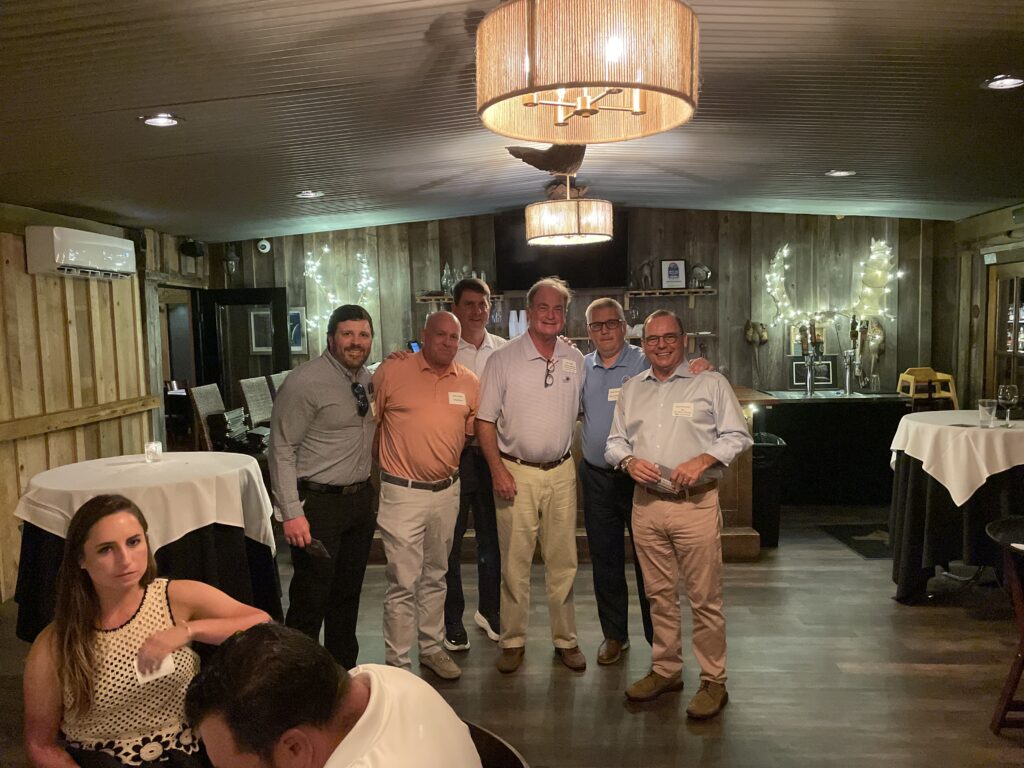
📸 Enjoy a few snapshots from our networking dinner at The Wash House—a perfect close to a wonderful day.
Thank you again, and we look forward to seeing you at next year’s outing!
Warm regards,
AMSCI Team








Upcoming AMSCI Events – Save the Dates!
ITFA / AMSCI Joint Webinar
Title: Navigating Tariffs, Trade, and Risk
Date: July 2025 (TBD)
Time: 2:30 PM ET
Format: Virtual (Zoom)
A timely discussion on trade policy, global risk, and supply chain resilience.
Official date and registration link coming soon.
AMSCI 74th Annual Dinner
Date: Wednesday, November 19, 2025
Time: 5:00 PM – 7:00 PM | Cocktail Networking Reception (Cambridge Room)
7:00 PM – 9:00 PM | Dinner (Harvard Hall)
Location: The Harvard Club of NYC
Formal dinner and networking in a historic New York venue.
RSVP/Registration
🎄 AMSCI Annual Gulf Region Christmas Dinner
Date: Thursday, December 11, 2025
Time: 5:00 PM – 9:00 PM
Location: Aspen Ballroom, The Houstonian Hotel, Club & Spa | Houston, TX
Celebrate the season with industry peers in a festive setting.
RSVP info forthcoming—early interest encouraged.