
June 2026 Market Update
Expectations are growing that the Federal Reserve is on a path to raise – not lower – interest rates this year.
Inflation has remained stubbornly high, and in May, the Consumer Price Index showed a 4.2 percent increase in prices during the previous year, while the Personal Consumption Expenditures Price Index – the Fed’s preferred measure of inflation – came in at 4.1 percent. The Federal Reserve’s target inflation rate is 2 percent, but the CPI has not been at or below that level since February 2021.
Energy costs, in particular, have driven prices higher this year, with the conflict in Iran tightening fuel supplies. The core inflation rate – CPI excluding food and energy – in May was 2.9 percent, according to the Bureau of Labor Statistics.
The economy, meanwhile, seems to be doing fine without additional help from monetary policy. The Bureau of Economic Analysis revised the first quarter growth rate upward to 2.1 percent, and the unemployment rate has held steady at 4.3 percent for the past three months and has not been higher than 4.5 percent since September 2021. Jobs growth in May totaled 172,000, exceeding expectations, and has been no lower than that since February.
Jerome Powell stepped down as Fed chair in May after a year and a half of frequent criticisms by President Trump that he was not doing enough to lower interest rates. But Trump’s appointee as Powell’s replacement – Kevin Warsh – voted at his first Federal Open Market Committee meeting in May to keep rates unchanged and has not given any indication since then that he will push for reductions.
The Fed’s post-meeting statement became shorter under Warsh than it was under Powell and the bulk of it stated, with the unanimous support of all voting members, including Warsh: “Economic activity is expanding at a solid pace despite elevated uncertainty that owes, in part, to the conflict in the Middle East. Productivity growth and capital investment are strong. Job gains have kept pace with the workforce, and the unemployment rate has changed little. Inflation remains elevated relative to the Committee’s 2 percent goal, in part reflecting supply shocks that have driven price increases in certain sectors, including energy. The Committee will deliver price stability.”
Fed statements typically use the same phrasing after every meeting, and even minor changes in wording are parsed for indications about future plans. The last sentence is a new one and – given the Fed’s dual mandate of maximum employment and price stability – might indicate that the central bank is now more focused on restraining inflation. The statement after the April meeting, in contrast, asserted, “The Committee is strongly committed to supporting maximum employment and returning inflation to its 2 percent objective.”
As a result of these factors, many analysts are now debating not if the Federal Reserve will raise interest rates this year, but by how much. Bank of America is predicting rate hikes totaling 75 basis points, and CME Group’s FedWatch forecasts a 66 percent likelihood of an increase of at least 25 basis points before 2027, with a nearly 1 in 3 chance of a quarter-point hike at the Fed’s July meeting. CNBC reported that, “Markets are also pricing in a 23.5% chance that rates will be at least half a percentage point higher by December.”
The target range for the federal funds rate is currently 3.5 to 3.75 percent.
Confidence in the manufacturing sector increased in May, with the Institute for Supply Management’s Purchasing Managers Index reaching its highest point in four years
“Looking at the manufacturing economy, only 2 percent of the sector’s gross domestic product contracted in May, compared to 19 percent in April, and the percentage of manufacturing GDP in strong contraction … was also 2 percent, the same as in April,” the chair of the institute’s Manufacturing Business Survey Committee said.
Notwithstanding the overall gains, several respondents to the institute’s May survey cited concerns about prices, the supply chain, and instability in the Middle East.
The Index of Consumer Sentiment from the University of Michigan Surveys of Consumers recorded a 10.5 percent increase from May to June, though the June reading was still well below the level of a year earlier.
“Expected business conditions over the next five years surged 16% as consumers’ worries over long-term consequences of the Iran conflict appear to be easing,” the Surveys of Consumers director said. “Still, sentiment remains in unfavorable territory at 13% below the February 2026 reading prior to the start of the Iran conflict, and nearly 20% less than a year ago. The cost of living remains at the forefront of consumers’ minds; for the third straight month, over half of consumers spontaneously mentioned that high prices are weighing down their personal finances.”
The Conference Board’s Consumer Confidence Index, meanwhile, reported a slight dip from April to May, with the board’s chief economist saying that a significant part of the reason for the decline was that “the inflationary impacts of the war in the Middle East intensified.”
Housing starts in May fell 15.4 percent from April and were 8.7 percent below May 2025, the Census Bureau and the Department of Housing and Urban Development reported. Existing home sales, though, increased 3.2 percent during that time, according to the National Association of Realtors.
“Improving affordability is helping drive this momentum,” the association’s chief economist said. “Even with mortgage rates ticking up compared to earlier in the year, they remain lower than a year ago and are essentially at the long-term historical average. Income gains are also outpacing home price growth by a small margin in most parts of the country.”
The Dow Jones Industrial Average closed at 51,876.11 on June 26, up 7.9 percent on the year and up 14.9 percent since the March 27 nadir of the month-long dip that followed the start of military operations in Iran. The S&P 500 Index ended June 26 at 7,354.02, recording a year-to-date gain of 7.4 percent.
The dollar, on June 26, was trading at 0.88 euros, 0.76 pounds, 161.81 yen and 6.79 yuan.
AMSCI Vice Chairman Marcio Barbosa Represents AMSCI at ITFA Americas 29th Annual Conference
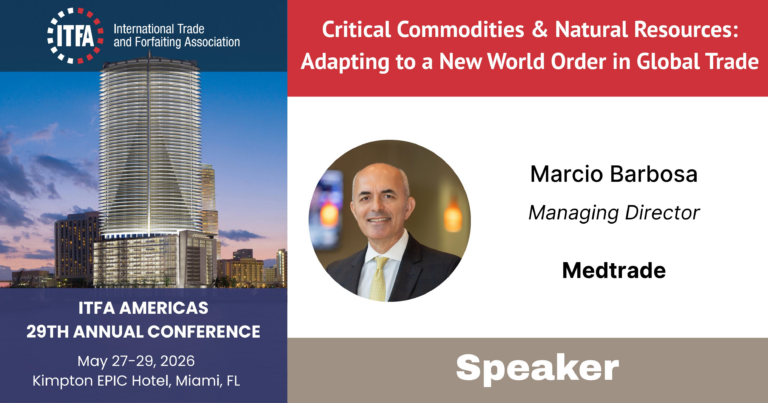
AMSCI Vice Chairman Marcio Barbosa represented AMSCI as a panelist at the ITFA Americas 29th Annual Conference, joining industry experts to discuss some of the key issues affecting global trade.
The panel covered the supply chain impacts of the Iran–U.S. conflict and how traders are adjusting their risk management strategies in response to evolving sanctions.
Marcio also spoke about the growing costs of importing, pointing to the impact of higher tariffs, increased customs bond requirements, and the rising financial costs associated with completing import transactions.
His participation highlighted AMSCI’s ongoing commitment to engaging in industry discussions and advocating for the challenges facing the trade community.
June 2026 Steel Shorts
Trump Reduces Tariffs on Some Metal Imports
President Trump on June 2 reduced tariffs on some steel, aluminum and copper imports.
Since his first term in 2018, Trump has aggressively imposed tariffs on imports of steel and certain other metals and their derivatives under Section 232, generally ranging from 25 to 50 percent, though lower for some derivatives and negotiated trade agreements.
In the latest adjustment to the levies, Trump stated, “recent circumstances have affected and are affecting domestic industries that use agricultural equipment, industrial equipment and machinery, and other related products. Many products in these categories are treated as derivative articles of aluminum or steel because they tend to be predominantly composed of aluminum or steel. These products also serve an important role in productive domestic economic activity.”
As a result, Trump temporarily reduced to 15 percent the tariffs on certain derivative goods, including agricultural equipment; HVAC systems and components that are predominately for residential use; and mobile industrial equipment and machinery (e.g., forklifts and bulldozers), though goods in the last category are only eligible for the reduction when they come from a nation with whom the United States has a trade agreement.
Trump also made other adjustments to the metals tariffs regime, including establishing an 85 percent melt and pour threshold (down from 95 percent) for goods to be considered as made “entirely” in the United States.
Steel Tariffs in U.S. Show Mixed Results: EuroMetal Report
Tariffs on steel and aluminum have done little to produce more jobs and have driven up prices for U.S. consumers, according to a report from the European Federation of Associations of Steel, Tube, and Metal Merchants (EuroMetal).
Citing statistics from U.S. government agencies and others, the trade association noted that the producer price index for iron and steel increased by more than 10 percent from April 2025 to April 2026 after such costs had been “relatively flat” for the preceding two years. The report attributed reduced construction spending partly to higher input costs, which also “have left some downstream sectors, including automotive and metals fabrication, to negotiate within their supply chains as they face tighter margins.”
While protectionist measures are typically intended to increase employment in the targeted sector, EuroMetal reported that, “The steel industry has added a few hundred new jobs in the past year as steel producers increased capacity, but employment in iron and steel mills and ferroalloy manufacturing has remained largely unchanged.” Employment in the overall manufacturing sector, similarly, has been static.
“Production is rising, and the industry is in a stronger position than 18 months ago,” an analyst at Wood Mackenzie told Platts. “But the output response has been gradual, reflecting the realities of building new capacity, and the broader manufacturing sector has yet to show a jobs uplift that can be tied directly to the steel tariff.”
New E.U. Steel Import Restrictions to Take Effect July 1
The European Union has officially adopted an aggressive set of steel quotas and tariffs that are intended “to protect the E.U. steel market from the negative trade-related effects of global overcapacity.”
The plan will slash steel import quotas by 47 percent to 18.3 million metric tons per year, which would match the import level in 2013, and will double the duties assessed when quotas are exceeded to 50 percent. The measure also includes “melt and pour” requirements intended to thwart circumvention.
“Steel is indispensable to Europe’s industrial base, its green transition, and its security,” Michael Damianos, minister for energy, commerce and industry for the Republic of Cyprus, said. “With today’s adoption, the E.U. is putting in place a stronger framework to respond to global market distortions, protect fair competition, and provide greater certainty for both steel producers and downstream industries.”
The measure will go into effect on July 1, replacing existing safeguards that are set to expire on June 30.
Separately, but similarly, the United Kingdom will cut its steel imports in half as of July 1, with amounts beyond the quota subject to tariffs of 50 percent of the product’s value. While the U.K. left the E.U. in 2020, The Guardian reported that, “The U.K. said it and the E.U. had agreed on an approach that reflected each other’s ‘highly interconnected supply chains’ after months of negotiations over retaining tariff-free access between the markets.”
Lawmakers ‘Anxious’ About USMCA Talks: New York Times
Members of Congress are reportedly becoming “anxious” about the status of the review of the U.S.-Mexico-Canada Agreement, The New York Times reported on June 19.
President Trump now expresses little, if any, enthusiasm for the trade pact – which he negotiated during his first term to replace NAFTA – and recently said, “I would rather not have the agreement, but I may sign it.”
Democratic lawmakers have sent multiple letters to U.S. Trade Representative Jamieson Greer in support of the agreement, stating in a May 18 missive that the USMCA is “vitally important to the United States’ economic security and prosperity.” On the other side of the aisle, the Times reported that, “Many Republicans have tried to walk a line of voicing support for USMCA while saying it has room for improvements.”
The paper noted that House Agriculture Committee Chair Glenn Thompson, R-Penn., said during a hearing in June that “the agreement had proved ‘extremely beneficial’ to farmers, ranchers, consumers ‘and the economy as a whole.’ But he conceded that it had provisions that could be improved.”
CUSTOMS CORNER
President Trump’s Executive Order “Strengthening Customs Enforcement” Affects Importers of Record, Enforcement and Penalties
President Trump issued an Executive Order on June 3, 2026 directing the Secretary of Homeland Security and U. S. Customs and Border Protection (CBP) to take a number of actions regarding the definition, qualifications and requirements for Importers of Record (IORs), both US and foreign (often known as non-resident importers (NRIs)) and bolstering enforcement, maximizing penalties and reducing allowed mitigation levels. The modifications affecting IORs are a response to enforcement and duty collection issues involving NRIs and so-called domestic “shell” companies that fail to pay required duties, fees, penalties and liquidated damages and have insufficient surety bond coverage and/or assets in the United States from which to collect. The changes, however, will also add additional identification, vetting, reporting requirements, bond and/or asset requirements, and other restrictions for all IORs.
The Order establishes fairly short time periods, ranging from 45 to 180 days, for the agencies to take specific actions. Some of the changes require statutory changes (from Congress) or a formal regulation change (subject to public notice and review requirements.) For these issues changes may be initiated but not completed during those periods; for other issues only agency policy changes may be necessary.
For purposes of the Order the term “U. S. IOR” means either an individual who is a U. S. citizen or permanent resident, or an entity organized under the laws of and located in the U. S., with controlling beneficial owner(s) who are U. S citizens or lawful permanent residents; or which, in the case of an entity, owns a significant amount of real property in the United States. “Located in the U. S.” requires both a principal place of business and a physical presence where significant business activity is conducted in the U. S.; and sufficient tangible assets located in the United States. All other IORs are considered to be a “foreign IOR.”
Foreign IORs are prohibited from filing informal entries and from using continuous Customs bonds for formal entries, except as permitted by CBP (meaning that single entry bonds will be required for most entries), and must either be CTPAT members if eligible or use a CTPAT verified Customs broker to file entries. Many specific details of these requirements are to be determined by the Secretary and CBP, either directly or through legislation or formal rulemaking. All IORs are advised to review relevant corporate information in preparation for these changes.
The Order also requires CBP to modify penalty mitigation procedures to apply a minimum mitigation level of 50% of the initial claimed amount. As the initial claim is often the full value of the shipment, or the full amount of the bond, and current procedures generally allow substantial mitigation for minor issues and for importers with a good compliance record, the new mitigated penalties could be substantial. The DHS Secretary and U.S. Attorney General are directed to prioritize enforcement in four specific areas: forced labor, misclassification, undervaluation and illegal transshipment. Seizure and disposal of noncompliant shipments will be streamlined, and such goods become much more difficult for importers to retrieve.
CBP may add restrictions for in-bond shipments, and is directed to increase audits. CBP is further directed to impose maximum penalties for Customs brokers who, for example, fail to conduct due diligence, repeatedly represent non-compliant clients, or fail to cooperate in a timely manner with requests for information by CBP.
The actions adding additional requirements for IORs and increasing penalty and liquidated damages liabilities are in line with many recent actions and proposals by CBP, but represent a continued shift away from the “informed compliance” and “shared responsibility” standards established in the Customs Modernization Act. Trade facilitation is no longer partnered with compliance concerns.
https://www.whitehouse.gov/presidential-actions/2026/06/strengthening-customs-enforcement/
Steven W. Baker
AMSCI Customs Committee Chair
swbaker@swbakerlaw.com
AMSCI 2026 Events Calendar
AMSCI 75th Annual Dinner (SOLD OUT)
Date: Wednesday, November 18, 2026
Time: 5:00 PM – 7:00 PM | Cocktail Networking Reception (Cambridge Room)
7:00 PM – 9:00 PM | Dinner (Harvard Hall)
Location: The Harvard Club of NYC
Formal dinner and networking in a historic New York venue.
🎄 AMSCI Annual Gulf Region Christmas Dinner
Date: Thursday, December 10, 2026
Time: 6:00 PM – 10:00 PM
Location: Aspen Ballroom, The Houstonian Hotel, Club & Spa | Houston, TX
Celebrate the season with industry peers in a festive setting.